

Search for a web design company with an AI assistant today and receive a recommendation directly without any browsing. According to Gartner, traditional search engine volume is expected to decline about 25% by 2026 as AI chatbots and virtual agents will get a good share of search queries meant for Google.
Search optimization has been divided into two disciplines. Traditional SEO continues to earn a business a place on a results page. GEO, or Generative Engine Optimization, gets a mention in AI-generated answers, often without a single click. Businesses that focus only on one of these are already losing bidders who have bypassed clicking search results.
What Is LLM SEO?
LLM SEO refers to the process of optimizing content so that it gets picked up, quoted, mentioned, or referenced inside an answer by a large language model like ChatGPT, Gemini, Claude and Perplexity. It’s further down the line than regular search optimization, but the goal has changed, not to rank anymore but to be named in the answer.
- Some models answer from training data alone. These systems draw on what they learned during training, without checking the live web at the moment of the query.
- Others retrieve live results before answering. ChatGPT Search, Perplexity, and Claude with web search all do a live retrieval step first and generate a response grounded in what they find. Having strong representation in training data is essential, but so is being easy to retrieve and extract from, at the moment someone starts asking a question.
Executing effective SEO in Hamilton requires optimizing for local search intent, managing Google Business Profiles, and building region-specific backlinks
What Is Traditional SEO?
Traditional SEO is the process involving search engines in order to get a high ranking on Google or Bing. So that people can click through to your site. For the past two decades, it has been constructed around keywords, links, speed, and matching content to search intent.
- The core toolkit remains established. Keyword research, on-page optimization, technical crawlability, link building, and page experience form the backbone of this discipline.
- It is not disappearing. Most AI engines still build on top of a conventional index. ChatGPT Search and Copilot lean on Bing, while Gemini and AI Overviews lean on Google. Ranking well in classic search remains a foundation that GEO is often built on top of, not a replacement for it.
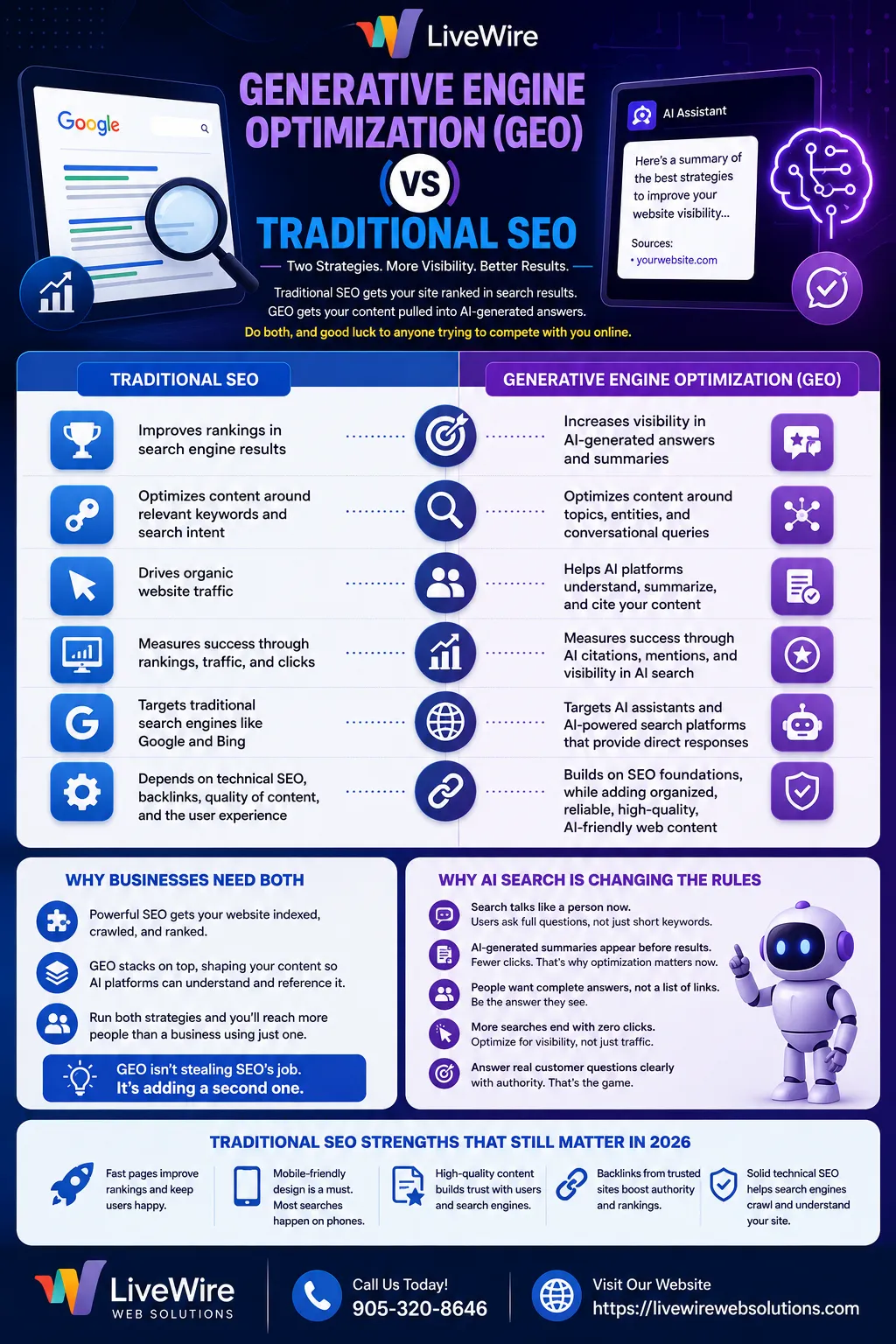
LLM SEO vs Traditional SEO: Key Differences
The clearest way to compare the two is side by side. Traditional SEO optimizes for a click. LLM SEO optimizes for a mention, and the two pull content in different directions.
- The content unit evaluated differs. Traditional SEO judges a whole page. LLM SEO judges individual passages, since a model scans for the single most extractable answer to a specific question and pulls it regardless of how the rest of the page reads.
- The success metric differs. The metrics that are conventional SEO measured against are ranking, organic traffic, and click-through rate. The metrics of LLM SEO are citation frequency and share of voice, as a business might get mentioned without a visitor landing on the site.
- The key signals differ. Traditional SEO rewards backlinks and domain authority. GEO rewards extractability, third-party mentions, and semantic clarity, meaning a page can rank poorly on Google and still be cited by an AI system if one paragraph answers a question with real precision.
Investing in professional SEO in Hamilton helps local businesses outrank competitors and capture high-intent traffic across the Greater Toronto and Hamilton Area
Where GEO, AEO, and SEO Overlap
These three terms are often used interchangeably, and that creates more confusion than clarity. Each one addresses a different piece of the same underlying goal: giving a genuinely useful answer to whoever, or whatever, is asking the question.
- AEO narrows the focus to the direct answer. Answer Engine Optimization is about formatting content to win a featured snippet, a voice assistant response, or a direct AI-generated answer. First-sentence answers, FAQ sections, and concise definitions carry most of this work.
- GEO is the broader discipline. It includes what Answer Engine Optimization AEO achieves, plus the off-site credibility signals that give a model confidence to attribute an answer to a specific source, such as genuine mentions on forums, review platforms, and industry publications the model already treats as reliable.
- SEO remains the layer underneath both. Crawlability, backlinks, and page experience have not lost their relevance. They are still the foundation that answer formatting and off-site credibility are built upon.
A business does not need to choose one over the other. Answer-first formatting makes content extractable, while off-site credibility gives a model enough confidence to name the source directly rather than paraphrasing it anonymously.
Practical Steps to Improve GEO Visibility
None of this requires rebuilding a content strategy from scratch. It largely means reviewing what already exists and tightening its structure so both search crawlers and AI systems can interpret it accurately.
- Review top pages for extractability. Confirm that the first sentence beneath each heading answers that heading independently. If it does not, the page is likely being overlooked by AI tools even where it ranks well in conventional search.
- Rewrite headings as genuine questions. A heading such as “How does local SEO improve visibility” is extracted far more reliably than a generic label such as “Our Approach,” since it mirrors how people phrase questions to an AI assistant.
- Audit robots.txt for unintended restrictions. Some AI crawlers are blocked by accident through overly strict crawl rules, cutting a site off from the visibility it is trying to build.
- Establish credibility beyond the website. Forums and industry publications are cited disproportionately relative to their size, so a genuine presence there strengthens the trust signals that support a citation.
Most businesses cannot dedicate the time this kind of audit requires while running daily operations, which is precisely where an experienced partner adds value. Livewire Web Solutions has spent over 15 years developing SEO and web strategy for businesses across Burlington, Oakville, and Hamilton, and has been incorporating AEO and GEO principles into that work as search continues to evolve. A business evaluating SEO in Hamilton providers should consider not only who can improve its rankings, but who understands how to maintain its visibility within AI-generated answers as well.
Ready to Build Your GEO Strategy?
Running two search strategies at once is no longer optional. Traditional SEO and GEO now demand different content structures, different signals, and different ways of measuring success, and neither can be skipped since most AI engines still build their citations on top of a traditional index.
If your business wants both tracks built and tracked properly, get in touch with Livewire Web Solutions for a free consultation. Find out where your current content stands on GEO and AEO visibility, and how a dedicated SEO Hamilton strategy can keep you ahead of the shift.
FAQs
1. What is LLM SEO?
2. How is LLM SEO different from traditional SEO?
3. Does traditional SEO still matter in 2026?
Yes. Most AI engines build their citations on top of traditional search indexes like Google and Bing, so ranking well in classic search remains a foundation for AI visibility rather than a separate concern.
4. Is GEO the same as AEO?
No. AEO focuses narrowly on formatting content to win a direct answer, such as a featured snippet or voice response. GEO is the broader discipline, covering answer formatting plus the off-site credibility signals that give AI systems confidence to cite a source.
5. How can a local business start improving its GEO visibility?
Start by auditing existing pages for extractability, rewriting headings as real questions, checking robots.txt for unintended crawler blocks, and building genuine mentions on forums and industry publications. A provider offering SEO Hamilton services with AI-search experience can run this audit as part of an ongoing strategy.
6. How can Livewire Web Solutions help improve my AI search visibility?
If you want to improve your visibility in Google, ChatGPT, Gemini, and other AI-powered search platforms, contact Livewire Web Solutions. Our team can assess your current SEO, GEO, and AEO strategy and recommend practical improvements. Call us today at 905-320-8646 to schedule a free consultation and discuss how we can help your business stay competitive in AI search.