
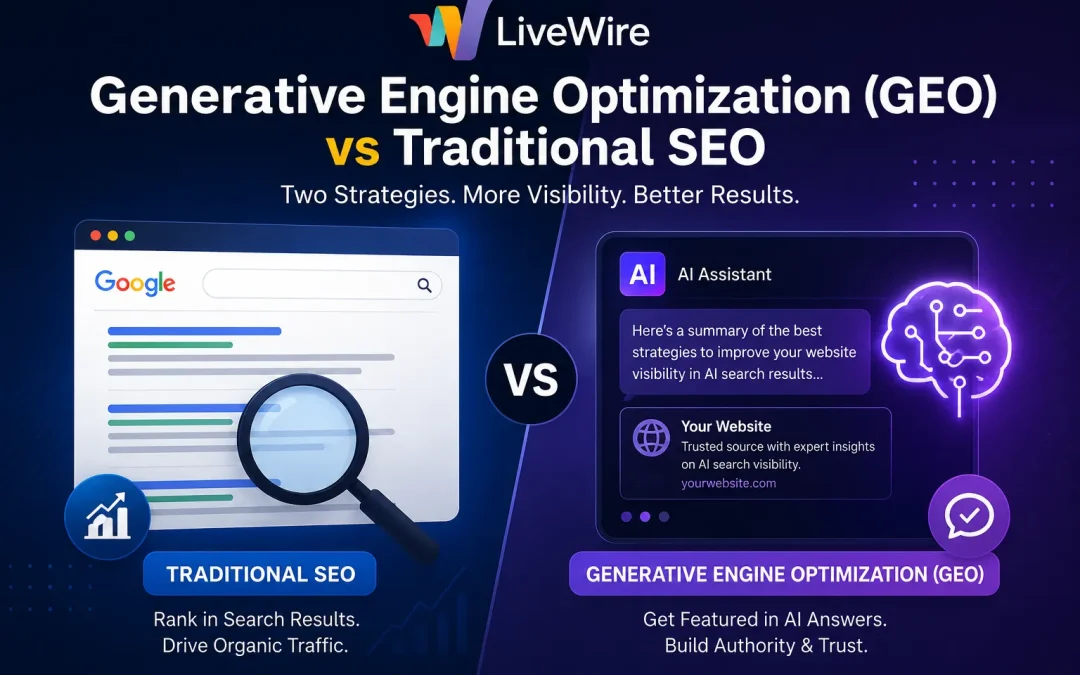
Traditional SEO continues to do the heavy lifting behind your online visibility. AI-driven search adds another layer to your digital strategy, one you shouldn’t skip. Search engines rank websites the way they always have. AI assistants gather their data from trusted sources and then serve it directly to the person who is asking. Find out how these two components work together, and you’ll be ahead of many of your competitors.
The term Generative Engine Optimization (GEO) vs Traditional SEO is not about fighting over the same territory. One gets your site ranked in search results. The other gets your content pulled into AI-generated answers. Do both, and good luck to anyone trying to compete with you online.
What Is Traditional SEO?
Traditional SEO means making your website simple for search engines to explore, index, and rank. Technical SEO, user-friendly, good content, internal linking, and backlinks are the tools. Make sure you have them, and search engines will better understand your website’s purpose and who it should be shown to.
What Is Generative Engine Optimization (GEO)?
GEO helps AI platforms understand, summarize, and provide references about what’s on your site. Write like a person talking to another person. Keep your structure clear. Stick to facts you can stand behind. AI assistants are more likely to generate accurate answers using your content.
Traditional SEO Still Builds the Foundation
No way around this one. Fast pages. Mobile-friendly design. Solid technical optimization. Content that’s actually useful. Backlinks are worth having. Skip any of these, and the rest of your strategy becomes less effective. Get them right, and you’ve got better rankings plus a better experience for anyone who lands on your site.
GEO Adds a New Layer of Visibility
AI-powered search hands people a new path to your business. Clear headings. Tight answers. Facts you can back up. Information that’s easy to scan. Continue doing this, and your content is more likely to appear in AI-generated answers. And no, this isn’t an AI search shoving Google rankings out of the picture. It’s just one more door into your business.
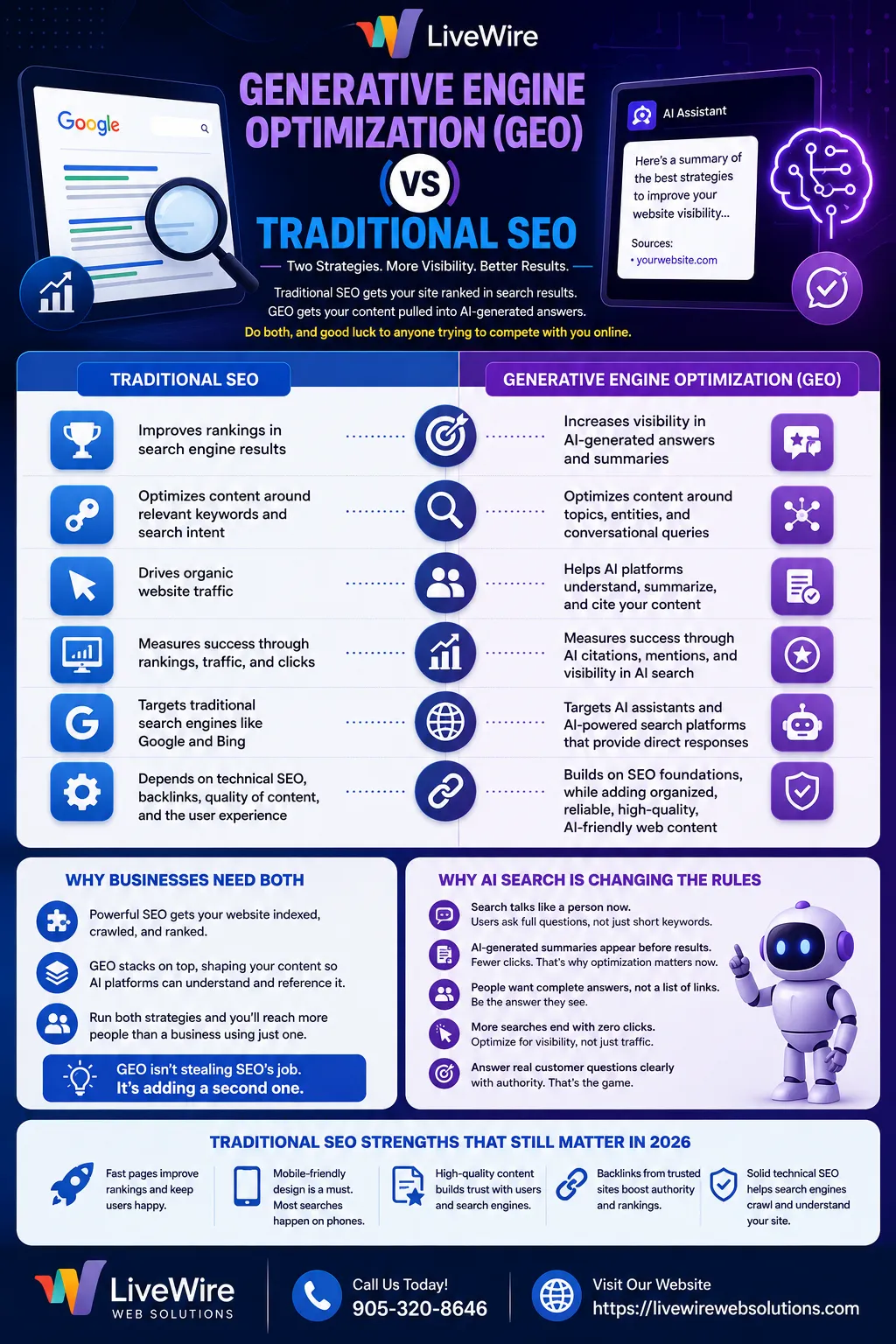
Key Differences Between GEO and Traditional SEO
Traditional SEO | Generative Engine Optimization (GEO) |
Improves rankings in search engine results | Increases visibility in AI-generated answers and summaries |
Optimizes content around relevant keywords and search intent | Optimizes content around topics, entities, and conversational queries |
Drives organic website traffic | Helps AI platforms understand, summarize, and cite your content |
Measures success through rankings, traffic, and clicks | Measures success through AI citations, mentions, and visibility in AI-powered search experiences |
Targets traditional search engines like Google and Bing | Targets AI assistants and AI-powered search platforms that provide direct responses |
Depends on technical SEO, backlinks, quality of content, and the user experience | Builds on SEO foundations, while adding organized, reliable, high-quality, AI-friendly web content |
Why Businesses Need Both
Powerful SEO can get your website indexed, crawled, and even ranked. That’s your base. GEO stacks right on top, shaping your content so AI platforms can actually understand and reference it. More people are relying on AI assistants every month. Run both strategies, and you will simply reach more people than a business running just one. GEO isn’t stealing SEO’s job. It’s adding a second one.
Why AI Search Is Changing the Rules for Businesses
Search talks like a person now.
Many users now search using conversational questions instead of short keywords. They ask, “How can I improve my website visibility in AI search results?” Full sentence, real question.
Google shows an AI-generated summary before you even scroll to the regular results. That summary answers things on the spot, so fewer people bother clicking through anywhere. Which is exactly why AI search optimization and Google AI Overviews optimization matter so much right now, this year, not five years from now.
Get ready for a conversational search. People increasingly prefer complete answers instead of browsing multiple pages.
Too many searches end up with a single click due to the fact that the answer is in the search results. Zero-click search optimization, in one sentence. Worth building into your strategy if staying visible actually matters to you.
Want a strong LLM SEO strategy? Answer real customer questions. Clearly. With authority. That’s genuinely the whole game, no secret sauce involved.
Traditional SEO Strengths That Still Matter in 2026
Don’t count traditional SEO out just because AI’s having a moment. Every advanced strategy out there still needs it underneath.
Traditional SEO allows search engines to crawl and understand your site efficiently. Speedy pages help keep users moving and boost search engine rankings as well. Mobile responsiveness? Not optional. Most people are searching from their phones anyway.
High-quality content remains essential. Solve an actual problem for someone, and you’ll earn trust from readers and from search engines; no tricks needed.
Internal linking ties your site together. Helps users find related content. Helps crawlers do the same.
E-E-A-T, which stands for Expertise, Experience, Credibility, and Authoritativeness, continues to influence the way search engines evaluate the content you’ve put out.
Create a clean and organized website first. Clear navigation. Solid structure. Strong local relevance. Get that right, and your AI-focused work performs better because of it.
Where GEO Gives Businesses an Advantage
SEO chases rankings. GEO chases something else entirely: showing up across every AI-powered search experience out there.
Write the way you’d actually talk, and AI systems pick up your context much faster. Add question-and-answer sections. Use headings that actually describe something. Make your explanations brief. Use this method, and AI models will summarize your information with precision more often than not.
AI-ready content presents facts clearly and consistently; that’s most of it right there.
Entity optimization helps AI understand the people, organizations, products, and services behind your content by drawing clear lines between related topics. That strengthens your entity-based SEO and makes life easier for AI systems trying to interpret you correctly.
Trust signals matter here, too. Accurate stats. Real expert insight. Regular updates. Sources people actually trust. Do all that and your credibility climbs.
Semantic search optimization today is about topic relevance, not stuffing keywords everywhere. Cover the concepts connected to your topic naturally, and AI systems trust your content as a source worth citing. Landing a citation inside an AI-generated answer can be just as valuable as a traditional click in building visibility and authority. Maybe more. It builds recognition and authority in one move.
How Businesses Can Combine Both Strategies Successfully
Combine proven SEO with AI-focused optimization.
- Start with technical SEO and site performance. If you skip this step, your AI-focused efforts won’t carry you far.
- Have subject matter experts answer customer questions accurately and thoroughly.
- Make use of structured headings and precise definitions so that AI and users can follow the same path without becoming confused.
- Add schema markup wherever it fits. This gives search engines extra context to chew on.
- Go back through your older articles. Update the facts. Swap in current examples.
- Publish comprehensive content across your areas of expertise, instead of scattering random one-off articles. That’s how you build real topical authority.
- Track more than rankings, too. Watch how your content shows up across AI-generated search experiences, right alongside the traditional stuff.
Livewire Web Solutions helps businesses adapt to both traditional SEO and modern AI search strategies, with optimization approaches built around long-term digital growth. Balanced approach. Sustainable visibility. Even as the technology underneath keeps shifting shape.
Is It Time to Move Beyond Traditional SEO Alone?
The traditional SEO strategy isn’t going anywhere. Make it a central part of your plan. That said, leaning on it alone can box you in as AI-powered search keeps growing.
Bring GEO into the mix, and you prepare for how search behavior keeps shifting, while still reinforcing all the SEO work you’ve already put in.
A future-proof SEO strategy comes down to three things: build authority, publish content people trust, and answer customer questions better than whoever’s down the street from you.
Stop scrambling every time an algorithm update rolls through. Build credibility across multiple search experiences instead, and your business holds steady no matter what changes.
Chasing better AI-powered search visibility pushes you toward quality over shortcuts, every single time. Clear information. Real expert guidance. Genuine value. That stuff holds up no matter how search technology evolves around it.
Businesses adapting now end up ahead of the pack later. Simple as that.
Building Visibility for Today’s Search and Tomorrow’s AI
Search keeps changing. The goal never really does, though. Consumers want reliable information, and they need it quickly.
Traditional SEO gives you the foundational technology behind high organic rankings. Generative Engine Optimization builds right on top, expanding your visibility across AI-generated search experiences by turning your business into a source AI systems actually trust.
Don’t pick one over the other. Run both. Invest in truly great content. Keep your traditional SEO up to date, address customer queries with clarity, and create credibility that lasts.
Companies that are prepared for the future stay ahead of industry changes instead of reacting after competitors adapt.
Livewire Web Solutions assists businesses in developing digital strategies to support traditional search engine ranking and AI-driven discoveries, thereby giving the business an even stronger base for the long-term development of its online presence. If you are looking to find for SEO in Hamilton support that actually encompasses both traditional and AI-driven search, begin here.