

Hours go into fixing pages and writing blogs. Keywords get squeezed in wherever they’ll fit. The site brings in a few visitors, nothing dramatic, but steady. Then someone asks an AI tool for a recommendation, and your business isn’t mentioned. Not once. That hurts, especially when you know your services could help.
Keywords aren’t the whole story, though. Search engines have to make sense of your business and the content you put out. Generative Engine Optimization (GEO) is one piece of a larger shift toward content that AI search systems can find and use more easily. Entity-based SEO supports that shift. Your business gets tied to the subjects, services, and expertise it really stands for.
Understanding Entity-Based SEO Without the Jargon
A specific person, business, product, service, or concept. Anything you can pin down. The word sounds technical. The idea isn’t.
Take a plumbing company as an example. Its site has a page on leak detection and another on pipe repairs. There are also a few articles about common plumbing headaches. Every page covers its own thing, but they all point back to one business and one line of work.
Search engines can pick up on those links with the help of entity-based SEO. They stop treating each page like a separate pile of words and use the whole website to figure out what the business does. Knowledge graphs sit behind a lot of this. They organize entities and the connections between them, linking a business with its services, people, subjects, and facts.
So what’s the practical bit for you as a business owner? Your site needs a clear identity. Visitors shouldn’t be left guessing about what you offer. Search engines shouldn’t be left stitching your expertise together from vague descriptions, either.
Why AI Search Needs Clear, Useful Information
Plenty of AI search tools pull from more than one source before writing an answer. The details change from platform to platform. Even so, the quality and relevance of the information matter. Some systems use retrieval-augmented generation, or RAG. It feeds relevant information into the process of building a response.
Think about a service page that only promises excellent results and happy customers. Pleasant, sure. A potential customer learns almost nothing from it. Then think about a page that sets out the problems the business handles, the services it offers, and what happens after someone asks for help. By the end, the reader has a much better idea of what they’d be getting.
That clarity helps search engines too. Entity salience is about how prominent a subject is inside a passage. A page that drifts between unrelated topics makes its main point harder to spot.
There’s no magic sentence that guarantees an AI citation. Platforms may weigh how useful the information is, how relevant it is to the question, what evidence backs it up, and other signals besides. Writing clearly doesn’t promise a thing. It just gives your content a fairer shot at being understood the right way.
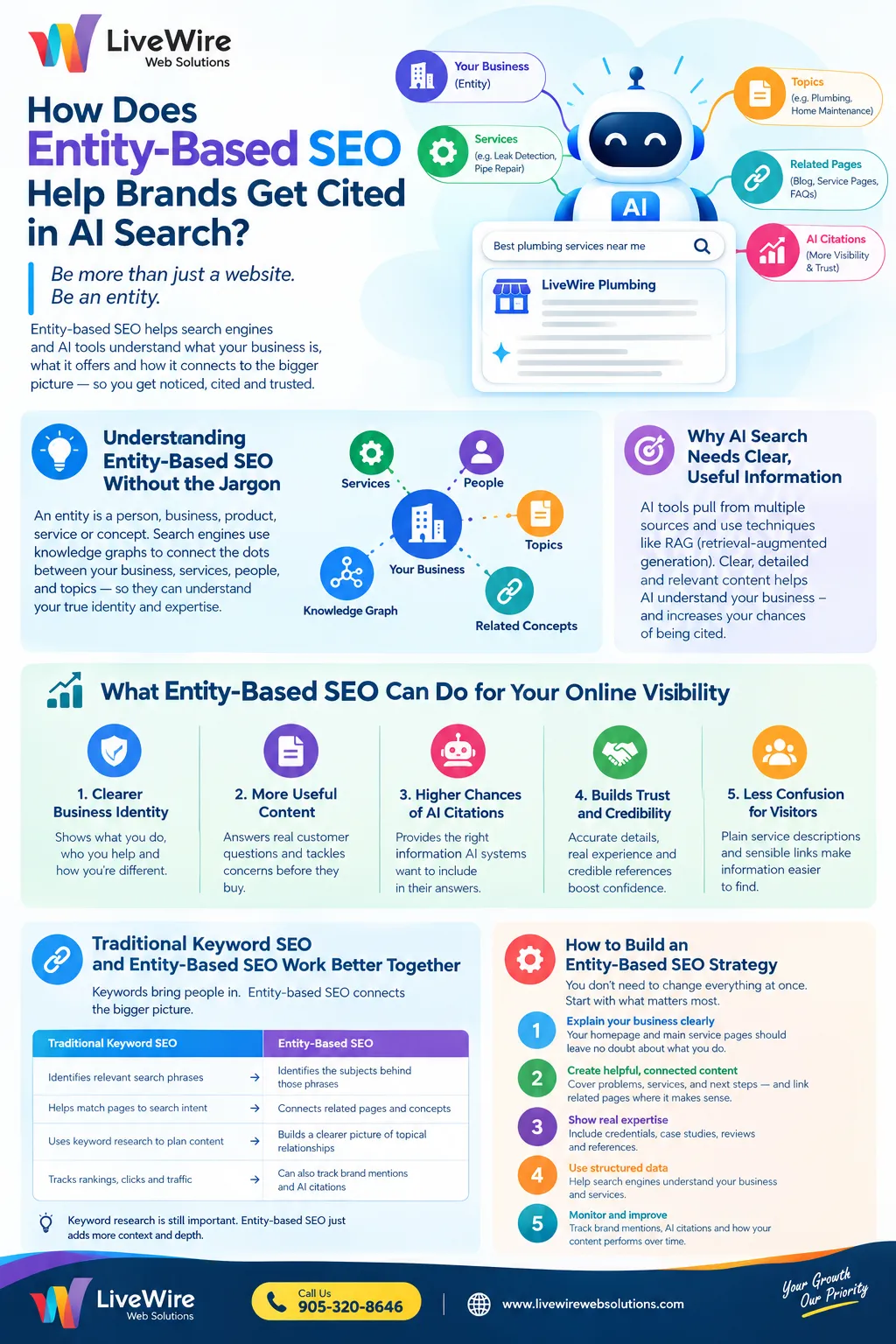
What Entity-Based SEO Can Do for Your Online Visibility
Technical stuff isn’t the biggest payoff here. Being able to explain your business properly, across the whole site, is. That shows up in a few ways.
Related pages show what your business does and which subjects fall within its expertise, so your services look clearer. You also end up with more useful content, because you’re answering the worries people have before they buy instead of publishing article after article on nearly identical keywords. AI systems need information to include in their answers, and a well-explained answer may be just the thing, so your chances of AI citations go up. Readers trust you more once they see accurate details, real experience, and credible references. And since plain service descriptions and sensible links make information easier to find, visitors get less confused.
Publishing more pages won’t get you any of this by itself. A small site with truly helpful content can show expertise better than a much bigger one stuffed with repetitive articles.
Traditional Keyword SEO and Entity-Based SEO Work Better Together
Keywords haven’t lost their place. They tell the terms people use to find solutions online and what they expect to get as an answer. Entity-based SEO looks past the phrase. Subject first, then related concepts, then the details that make an answer worth reading.
Traditional keyword SEO | Entity-based SEO |
Identifies relevant search phrases | Identifies the subjects behind those phrases |
Helps match pages to search intent | Connects related pages and concepts |
Uses keyword research to plan content | Builds a clearer picture of topical relationships |
Tracks rankings, clicks, and traffic | Can also track brand mentions and AI citations |
Let’s say keyword research shows people want to learn about a particular service. Great. That’s your starting point. A main service page comes first, then a helpful explanation of the usual problems, with a link between the two wherever it fits. Different sides of the same subject, so the pages support each other. Keyword research stays in the picture. It simply has more context around it.
How to Build an Entity-Based SEO Strategy
Changing every page at once isn’t required. Begin with the pages that matter most to your business and take your time with them.
- Explain your business clearly. Take a good look at your homepage and main service pages. Anyone who lands on them should be able to tell what you do, who you serve, and what you offer, without reading the entire site. If they can’t, fix those descriptions before anything else.
- Cover the topics customers care about. People have questions long before they pick a service. Answer them. Common problems, available options, and practical points to weigh all deserve a helpful explanation.
- Give important services their own space. Got more than one service? Fine. Every major one still needs a clear explanation. Pile unrelated subjects onto one page and visitors have to dig for details.
- Link pages that belong together. A blog post about a common customer problem can link to the matching service page. The service page can then send visitors on to a deeper explanation when they want one.
- Use examples instead of empty promises. Show how a service works. Say what a customer can expect, or which factors shape the outcome. Any factual claim needs reliable sources and real expertise behind it.
- Know when to seek help. Maybe you’re weighing up an SEO company in Hamilton your business might hire, such as Livewire Web Solutions. Look closely at the approach they actually offer. Good support covers content, technical issues, site structure, and performance. It doesn’t rely on promises of quick rankings.
What you’re after is a website that makes sense to people first. It should also tell search systems, clearly, what it’s about.
Making Structured Data and Technical SEO Work for You
Good writing is half the job. Search engines also need to reach your pages and read what’s on them.
Schema markup gives structured information about content. Organization schema can describe a business, and Person schema can identify an author when that information is relevant and accurate. With the sameAs property, you can connect an entity to its real, official profiles. There’s one condition. Those profiles must refer to the same person or organization.
Some basic technical checks help too. Crawlers should be able to open your important pages, and those pages should be eligible for indexing. On mobile, visitors should be able to use the site comfortably. Structure matters too, so keep it sensible.
Skip structured data that’s only there to tick a box. It has to match what’s visible on the page. Schema may help search engines interpret content, but higher rankings and a spot in AI-generated answers aren’t guaranteed.
Entity SEO Mistakes That Can Hold Your Website Back
Certain habits make even useful content harder to understand.
Stuffing keywords everywhere is one. Write naturally and use a phrase only where it fits the subject. Thin pages are another, so give readers enough detail to understand the topic or make a decision. Mixing unrelated subjects causes trouble too. Keep each page focused and connect related content with sensible internal links. Incorrect schema markup is a fourth, and structured data should always reflect what visitors can actually see. Then there’s stale information. When things change, go back to your service descriptions, author information, and key claims. Last, don’t expect results overnight, since search engines need time to find pages and process changes.
Here’s an easy exercise that tells you a lot. Take one of your main service pages and read it with fresh eyes, as though the business is new to you. Finished and still can’t say what the service involves or who it helps. Then that page needs work first, before you add anything else.
Measuring Progress in AI Search Visibility
Rankings are easy to fixate on. But they’re one part of the picture. Organic clicks, impressions, relevant search positions, and conversions deserve attention too, and your analytics and search performance tools can show them.
Realistic customer prompts are worth trying across different AI search platforms as well. See whether your business shows up. See whether a page gets cited. Watch how the answers shift over time. Referral visits from AI platforms and relevant brand mentions are worth checking too, where the data exists.
If you’d like help making sense of the results, an experienced SEO Company Hamilton businesses trust should be able to explain what the data really shows. They can also tell you which changes deserve your time next.
Keep this in mind. AI answers differ between platforms and searches. One appearance, or one missing citation, doesn’t tell the whole story. Look for patterns rather than judging progress by a single result.
Building a Stronger Foundation for AI Search
Entity-based SEO helps search engines get a clear sense of the business behind a website. That’s the whole point of it. Your services, useful content, supporting evidence, and the links between related topics all get pulled together. It also works alongside the SEO practices you may already use.
Start small. Pick one important page and make its purpose clearer. Add details that truly help visitors. Connect it to relevant content elsewhere on your site. After that, move on to the next area that needs attention.
Chasing every new trend isn’t necessary to make progress. A website that explains things well and gives people reliable information is a far better place to start.
Contact us at Livewire Web Solutions to talk through your SEO goals. We’ll help you find practical ways to make your website more useful to visitors and easier to understand in AI search.